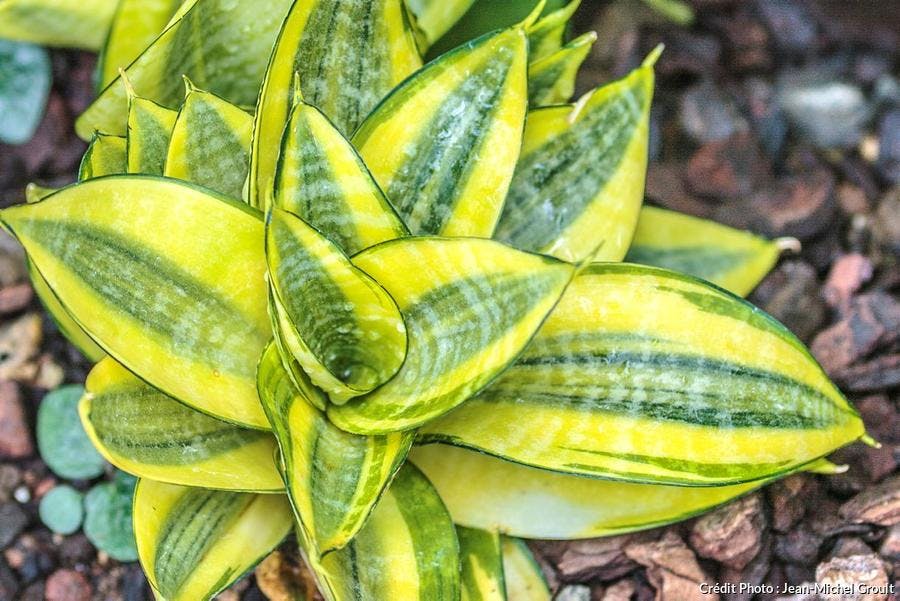
The flower, a small reward
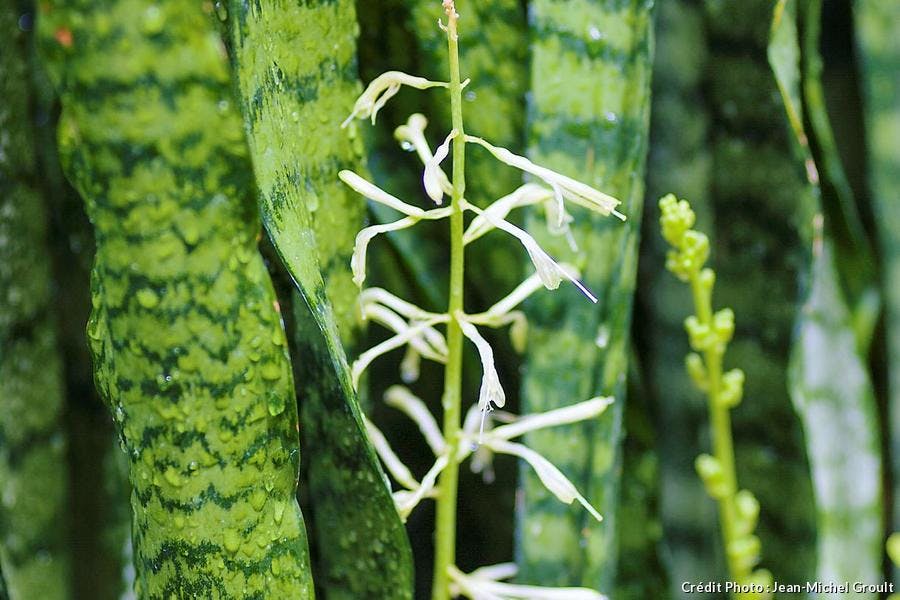
When it pleases, sansevieria flowers in a spike that is not spectacular but exudes a sweet smell. And a fragrant bloom in the house is not so common! It requires full sun and hates having roots that are constantly soaking: empty the saucer after watering.
A beautiful sansevière and effortless maintenance
The sansevière is native to somewhat desert regions, where it grows naturally in the shade of bushes. Indoors, she, therefore, likes dry air and that's good because the air in our homes is arid! A little sun each day promotes more colourful leaves, especially in variegated sansevières. She likes regular water, once a week. Excess water is its biggest enemy and the root ball must dry out well before watering again. If you're the type to forget to water your plants, go on vacation without finding the time to water your pots or you have the intermittent watering can, no problem: mother-in-law's tongue supports it perfectly. When her leaves start to wrinkle, it's really time to give her a drink, but she won't give you that signal until after several weeks of dry diet.
Write to us or call to join us.
When to water and what soil for sansevieria?
When you report the sansevière, use potting soil for houseplants.
Water your sansevière by incorporating a little liquid fertilizer, once every three weeks, from April to September. If the plant is cramped, it will need to be divided or repotted. To change the pot (repot it), nothing could be simpler: take it out of its pot, and simply replant it in a 5 cm wider pot. Always choose a pot with a straight or flared floor, never narrower than the rest. Use potting soil for indoor plants. Avoid garden soil and compost, which are not his forte.
How to take cuttings and divide sansevieria?
The simplest way to multiply a sansevière is by division. Take the plant out of its pot and slice it into the mass, in two pieces. To do this, use a sharp kitchen knife and keep children away! Separate two large shards that you will replant each in their own pot or in the same planter, spacing them 30 cm apart. Water very little for a month, while the cut wound heals well.
The benefits of mother-in-law's tongue
According to some garden centres or works popularizing and marketing plants, the species has the reputation of being depolluting. But this is denied by scientific studies
Trifoliate Sanseverine has the ability to metabolize four of the five main airborne toxins implicated in sick building syndrome but the depolluting effect is negligible compared to the need under real-world conditions even though the plant slightly improves the performance of an activated carbon filter5. For formaldehyde and xylene, it is respectively per hour, under certain laboratory conditions, 189 and 157 micrograms which are absorbed by the sansevière, that is to say almost ten times less than the Boston fern in the first case, more than three times less than the date palm of the Mekong in the second6.
The cuttings of the sansevière
More unusual, the other solution consists in making leaf cuttings. Cut a beautiful leaf at the base. The sheet should preferably be flat. Cut it into portions about 10 cm long, and leave to dry for a week.
Then replant them in a very light substrate (sand or vermiculite) and let them root. After three weeks, each portion will have formed roots and started to put out its own leaves, but it will take a year before you have a full plant.
Write to us or call to join us.
Where to buy this plant and at what price?
You can buy Calathes in traditional garden centres, florists and even in large stores such as Afique Santé Bio. It is also possible to order them online on sites like afriquebio.com. You can find these plants for between 10 and 20 euros.
Make an appointment with lady feranmi on:
Appointment
E-mail